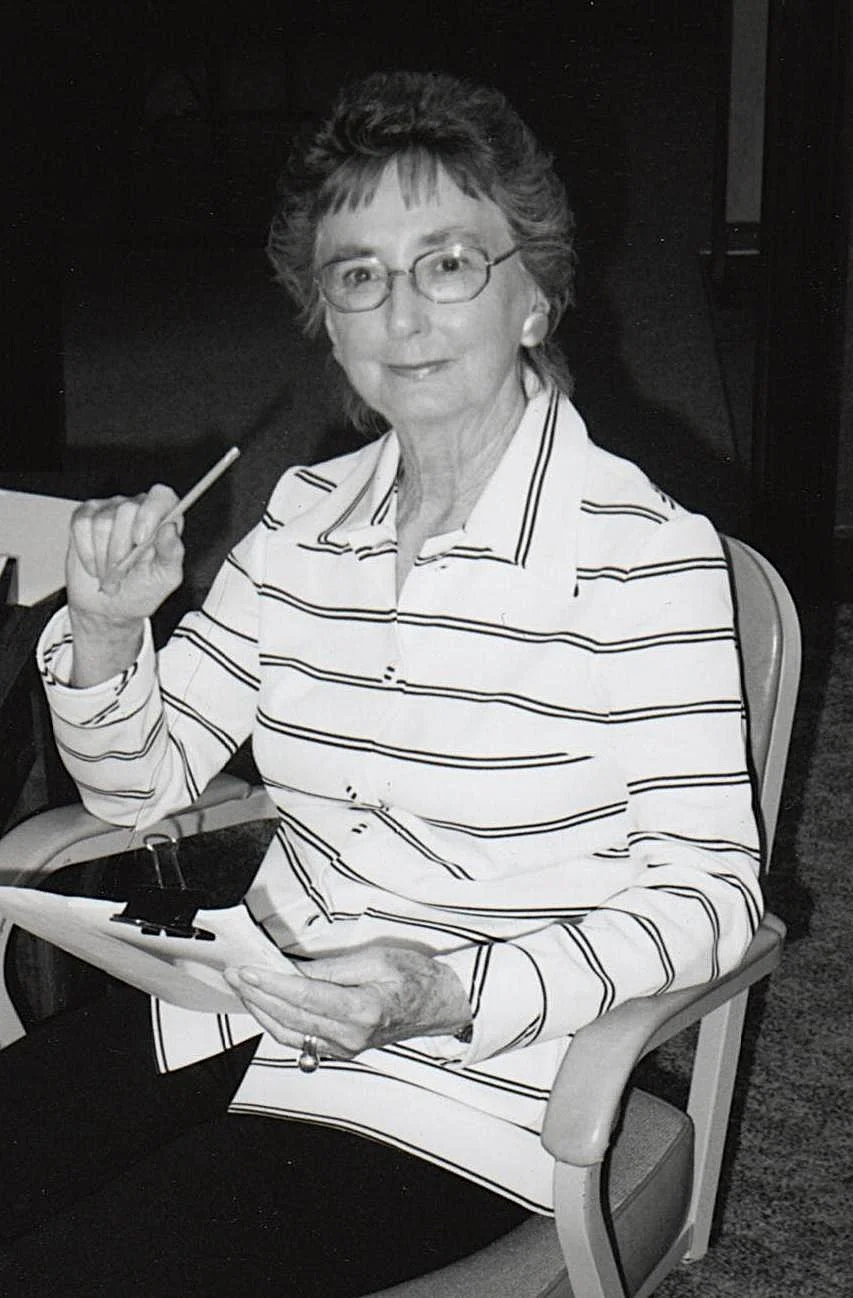
Aileen’s tips for your own writing
“You are unique,” Aileen told people whenever she talked about writing. “Nobody else in the whole wide world has the same story to tell that you do.” She believed that everyone has a story worth writing, and that you’re never to old (or too young) to write it.
Here are some of her suggestions to help you write your story well, whether it’s for children or adults, fiction or nonfiction.
Always have a note-taking method handy and when you think of a particular memory, a possible plot detail, or a good way to phrase something, jot it down at once. Keep paper and pen at hand, or dictate notes to your phone, or send a quick text to yourself. We think we’ll remember till we reach our computer—but we often don’t.
Organize your notes. Keep file folders on paper or computer.
Read books in the genre you plan to write in. What works and what doesn’t?
Read books and articles on writing, though not to the exclusion of your own writing time.
Write. Write anything! Aileen always said, “Nothing you write is ever wasted. It all helps you become a better writer.” Put pen to paper or fingers on keyboard. An old rule is to get the seat of your pants into the seat of your chair. James Bond author Ian Fleming called this the Rule of Enforced Boredom, when you give yourself only two choices: stare at a blank wall or start typing. Minimize distractions—phone muted. Aileen didn’t follow this rule fully; she always answered her phone while writing, and if her cats clamored for attention, she’d give it to them, even if they had just walked across her keyboard and deleted a page. The husband of French novelist Colette sometimes locked her in a room until she turned out a certain number of pages—which he then published as his.
Do take breaks while you write! Take some deep breaths, move around the room from time to time.
How to start? Don’t stress over the opening or the title. You’ll change them over the course of the book. There’s no need to start at the beginning if that’s holding you back. Write one scene. Write a favorite anecdote or memory. Write a letter or email to someone in your book. You can move the paragraphs around and add to them later. Just get something written down. Momentum will build as you write.
For the first draft, just write the basic story. Don’t spend too much time trying to make it perfect! When you revise, you’ll clarify and spice up your writing.
Have backup and use it. After every writing session, either email the new pages to yourself, or print a copy, or snap a photo with your phone. Losing your work is so discouraging, it makes you want to give up. Aileen had this happen more than once. She allowed herself a brief wallow in self pity and then sat down and rewrote the lost section.
Revise! Shorten paragraphs that are too long and avoid “info dumps” where you stuff too much information into one spot. Look for places where you can use a stronger verb. Read poems to see how one vivid verb can take the place of a whole descriptive sentence. In poems, every word has to be exactly right with no excess, and you can apply this lesson to any form of writing. Use all five senses but work them in a little here, a little there. Search for adverbs ending in “–ly” (happily, easily, loudly, angrily, carefully) and take many out, also limit “just” “really” “nice” and “very” which are overused words. Say it once, say it right, and move on.
Don’t be afraid to cut. Aileen kept old versions as she revised so if she decided later to put back in something she’d cut, she could retrieve it. But she almost never did—the new version was better. Beware the sagging middle! That’s where we craft a gripping start to our book, and a satisfying end, but we cram into the middle everything that wouldn’t fit elsewhere, making readers bored or confused.
One of Aileen’s favorite writing tips was “Read your work aloud!” You’ll be amazed at how reading your writing aloud, to yourself, helps you see places that you can improve.
Join a good critique group, in person or online. Friends and relatives are fine cheerleaders but may not be the best critiquers because they don’t want to hurt your feelings. What makes a good critiquer? Not someone who praises your piece without reservation and says “It’s perfect! Don’t change a word.” And not someone who says your work is stupid or terrible and you can’t write. A useful critique mentions things that are good about your work but also points out places that the critiquer feels could be better: it may be a continuity problem, where you have the character finish breakfast in one paragraph and then sit down to start breakfast in the next paragraph. Or it may be a grammar or spelling error. You’ve read your manuscript so many times that you don’t notice these mistakes. You don’t have to make every change that every critiquer suggests—think about the comment and you decide.
Focus and finish. Revise again. It’s important to make your manuscript as free of errors as possible. If you’re not good at proofreading and aren’t sure whether your critiquers have caught all the typos, misspellings, and so forth, consider having a professional read through it before you publish. You want your book to cast a spell on readers. That spell can be broken by a sentence that doesn’t make sense, a paragraph that’s repeated, or too many typos.
Be aware there are some scams in publishing and in publicity. There are also legitimate offers that may not be financially wise for you. If you decide to pay to have your manuscript published, thoroughly check out the company. Don’t expect your book to make you rich. Look for it to be satisfying in other ways.
If it won’t make you rich, why write a book? Many reasons: write it for family and friends, for acquaintances, for total strangers who’ll come across it and find your book helpful and enjoyable. Write it for yourself, because you have something to say! Write because you like being part of a community of writers. Write because you’re driven to write! Books have a miraculous power: you can talk to people who won’t be born until long after you’re dead. You don’t know who will read your book a hundred years from now. Your work will connect you to them and let them see life through your eyes.